update 1-11-2022: “Surprisingly” there seem to be extremely favorable reviews of this shredder on youtube. Interestingly some of those reviews claim “to not having been sponsored by the manufacturer” and therefore imply “objectivity” – while providing direct online shop links to sellers of this product and admitting that they might receive affiliate kickbacks for sales made in those shops.
One might be tempted to think that eventhough the financial incentives of the authors of those videos obviously go into a certain direction, the exclusively positive comments below those videos actually reaffirm the review result, right? Not so quick! I just learned that censorship on youtube cannot not be underestimated. To add some balance I had just left a link to my less than positive review (see below) on one of those pages (see https://www.youtube.com/watch?v=1y410OOy_E0 ), only to find that after a few minutes my comment had already been removed. You might want to keep that in mind when you watch fanboy “product reviews” on youtube.
————————————————————
The “Bosch AXT 25 TC” shredder supposedly is “extremely fast” and deals with branch diameters up to 45mm. So much for the advertising claims.

Here the flaws that I encountered during my first year of using this toy:
- Maybe the tool is “extremely fast” if compared to a sloth. In fact it takes ages to process branches through the small input opening.. it is anything but fast.
- The tool is of such poor build quality that it actually started self-destructing the metal casing of the “turbine” (see photo above: a large metal section has actually broken off – this happened while shredding normal branches well within the specified range!)
- The “child-proof lock” of the tool malfunctioned after a couple of weeks and the whole shredder had to be sent in to repair the electronics. Luckily this was still on warranty. Next time this happends Bosch will likely sell me the tiny replacement circuit board for 80 Euros apiece. (At least this incident gave me the “opportunity” to have a look at the steep prices Bosch asks for the various spare parts.)
- It took not long for both of the wheels to fall off. Each is normally held in place by a cheap plastic bolt – which breaks in no time..
- In any case the wheels are pretty useless in most circumstances: The wheelbase is much to narrow and the center of gravity much to high so that the shredder will invariably tilt over whenever you try to move it – even on flat terrain.
At the time I had bought the shredder for around 500 Euros. It isn’t worth the money, not at all.
Update 2018: So it happend again.. the previous day it had still functioned.. next day the Bosch shredder was “dead”. When trying to repair it myself this time, the root cause was quickly found: One of the “child-proof switches” (which checks if the feed hopper is actually screwed on) was barely recognizable as a switch – it had completely disintegrated/melted. As soon as I shorted the repective wire and cleaned the PCB (see below) the shredder worked again. Since I had already opened the device I decided to keep going to also sharpen the dull blades. Here the additional findings about this piece of junk that Bosch calls a shredder:
- It is a major pain in the ass to disassemble this piece of junk. One problem is the removal of the plastic cover (to access the motor, etc): There is one pin in an almost inaccessible position under the cover and it must be removed before the screw that blocks the cover can be removed. The plastic cover must be bent considerable before the pin can even be reached. Alternatively the similar pin located on the “red knob” side can be pushed out to then pull off that knob – the ticky bit is to find a nail with a suitable diameter to do the pushing. Another example of Bosch’s “serviceing unfriendly” design are the 6 torx screws that hold the respective black cover from the underside of the device: Apparently for no good reason has Bosch added narrow tubular collars around those screws which means that you’ll not be able to reach those with your exchangeble bit-holder based screw driver. Reassembly is even more fun 🙁
- The lack of proper dust/dirt protection for the printed circuit board (PCB) of the shredder seems grossly negligent: When I opened the compartment there was a thick/moist layer of dust covering the complete circuit board. No surprise to me if those electronics malfunction. (Bosch seems to have used some kind of lacquer to add protection for some components on the PCB – but this looks like a hack to fix the underlying dust/dirt issue.)
- The solder joints attaching the wheel shaft to the chassis were actually *all* broken (not rusted but just broken). I would not manage to create such a lousy quality solder joint even if I tried very hard.
- The blade-turbine can only be accessed (e.g. for replacement or maintenance) when the motor-unit is first completely removed from the device. It seems that Bosch does not mean for this shredder to be serviced with ease!
- Of the four screws holding the blade-turbine, one had already broken off – with only the stump still visible in the screw hole (see photo below). But when I removed the remaining three screws it became apparent that all but one were already broken somewhere in the middle and were barely holding on with what little remained of the screws. Update 2-11-2022: A friend (who is a professional mechanic) had kindly removed the broken off screw parts from the holes eventually (without a suitable drill press repairing this kind of problem likely exceeds the capabilities of most users) and provided me with four high-quality replacement screws – but these screws also started to again break a few month later. To me this suggests that the respective 4 screw design chosen by Bosch is just not adapted the forces provided by the motor/gearbox.

In my opinion the build quality of this badly designed, self-destructing piece of junk is a shame and Bosch did everything to ensure that broken stuff cannot be easily/cheaply repaired.
update 1-11-2022: below some tips that may or may not be useful to other users of this garbage product.
A repeated source of malfunctions were defects of the various “safety switches” used in my device: The device uses redundant mechanical and Reed (magnetic) switches to make sure that the motor “cannot” be accidentally started while any components that prevent direct access to the cutting turbine are not properly installed (i.e. leaf collection box, feed hopper). Obviously the cutter turbine may potentially cause very serious injuries and you don’t want have any limbs near it while it is turning (you wouldn’t want to put your hand into your kitchen blender while it is running either – in spite of there not being a “is the lid on” safety switch in most of those devices). Depending on who might have access to the device (children, etc) you might still want to leave the shredder’s safety switches intact!
That being said I think there are other ways to handle the device safely without those safety switches (provided you can restrict access for unautorized users and you don’t intend to sell the device to unsuspecting new owners eventually), e.g. I always *unplug* the device before moving it or before performing any manipulations anywhere near the cutter turbine. When I see that the respective original mechanical switches just melt/disintegrate or that Reed switches fail due to the counter-magnet falling out (etc), and if I consider the ludicrous spare part prices asked by Bosch, and if I then take the “servicing unfriendly” design into account (that makes any repair just a pain in the ass), I see more benefit in removing unnessary failure points that provice little added value to me. Example: Reed switches are designed to provide little resistence (I measured ~0.7 Ohm) while in the “happy” configuration, which means that in order to disable them completely from my experience it is good enough to just short the respective connector. With those sensor wires out of the way this has the added benefit of making the next disassembly/assembly a bit easier. (The two mechanical “safety switches” are wired in series to the two outer pins on the connector that connects to the mains power. These switches can be similarly disabled by just shorting the respective wires.)
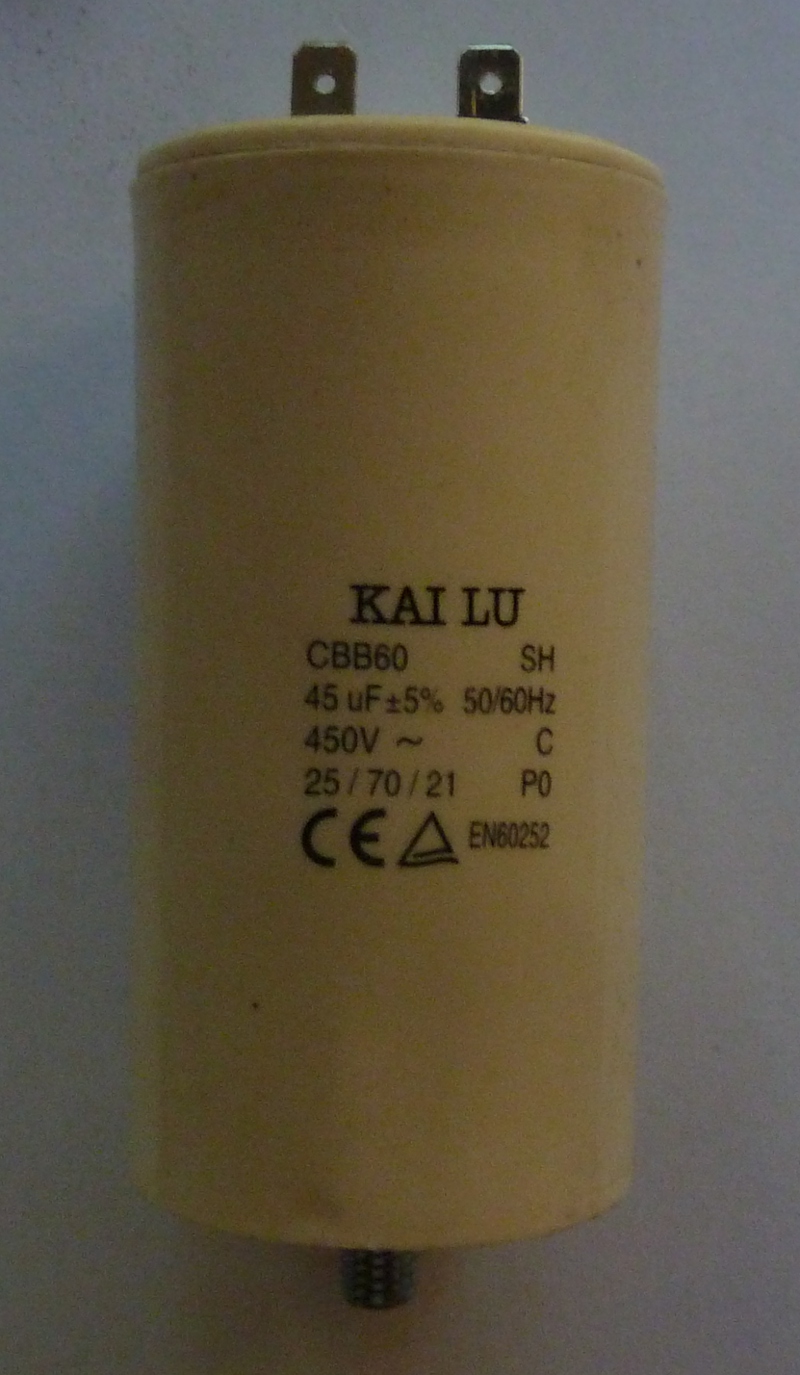
In case you ever need to change the motor capacitor: The capacitor is screwed in, i.e. you turn it counterclockwise to remove it. The component used in my shredder was a: KAI LU, CBB60 SH, 45uF +-5% 50/60HZ, 450V ~ C, 25/70/21 P0 (see photo below). Those things sell around 7-15€ Amazon/AliExpress and there is probably no good reason to pay the inflated “original Bosch” spare part prices.
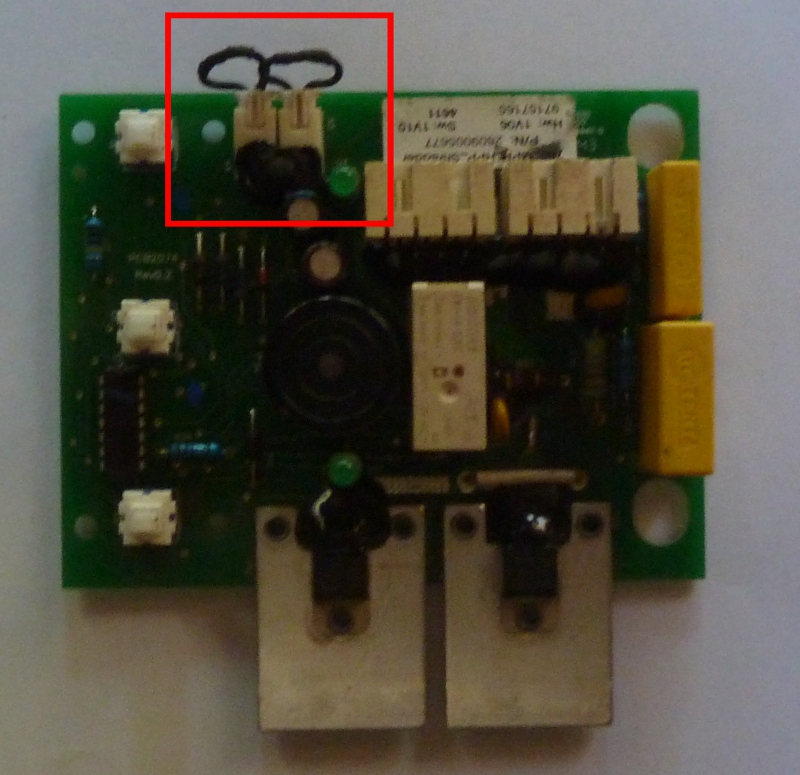
My device recently started to show erratic behavoir, i.e. it would suddenly no longer turn on (after having run for the previous hour) – just blinking the green led instead. After some month in the garage it would again work just to fall into the same pattern after some use. I measured the capacitor and found that my original part had degraded to a point where it only had 35uF (instead of 45uF). Unfortunately replacement with a new 45uF capacitor did not help. I suspect that it is a problem with the main control PCB – which probably self destructed (once again) – see respective similar issue that had occured to my device during the warrany period. Unfortunately respective schematics for this main board are nowhere to be found and depending on what is broken it might be difficult to fix (e.g. Bosch does not seem to provide the firmware used on the PIC16 micro processor either – i.e. you’d have to make a firmware backup from your respective device while it still works).
Since I had already disabled all the “child safely” features, the control electronics provided very little added value to me anyway. I therefore decided to also get rid of this error prone failure point on my device and just replace it with a simple but robust mechanical switch. A respective “Rotary Cam Selector Switch” (3 positions, 3 phase 12 terminals) allows to turn on/off the motor while also selecting the direction.
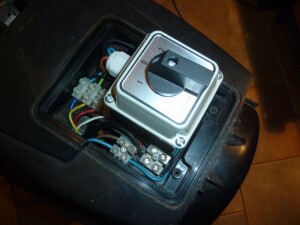
And “hurray” now my garbage Bosch shredder works again. The hack comes with a tradeoff though: The motor is no longer turned off / reversed automatically when something blocks the cutter turbine, i.e. the respective intervention has to be performed manually and reasonably quickly.
In case you want to try this hack yourself here some information that might be useful (USE AT YOUR OWN RISK! THIS INVOLVES HIGH VOLTAGE COMPONENTS THAT MAY POTENTIALLY CAUSE SEVERE INJURY AND/OR DEATH. WHEN IN DOUBT THEN DON’T!):
Precautions:
1) Always unplug the device before tinkering with the electrical parts!
2) The main motor capacitor may still contain a significant/dangerous charge even after the device has been unplugged: Do not touch any electrical components before you have also verified that the motor capacitor is COMPLETELY empty! (You might use a well isolated electrician’s screwdriver to directly short the two terminals of the capacitor. Make sure that your body is NOT involved in any way in the shorting of the cap! THIS IS DANGEROUS!)
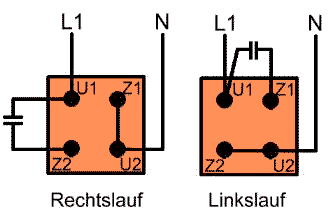
The motor contains two independent coils: the main coil (blue/yellow wires; corresponding to U1/U2 in the below diagram) and a starter coil (red/white wires; corresponding to Z1/Z2). In case Bosch has changed the coloring of the wires you should verify the resistance of the respective coils: the resistance of the starter coil should be about twice the resistance of the main coil.
Wiring is pretty straight forward and respective background information can be found here: https://www.elosal.de/ratgeber/drehrichtung/index.php . This is what the respective circuits must look like in order to make the motor rotate in one or the other direction.